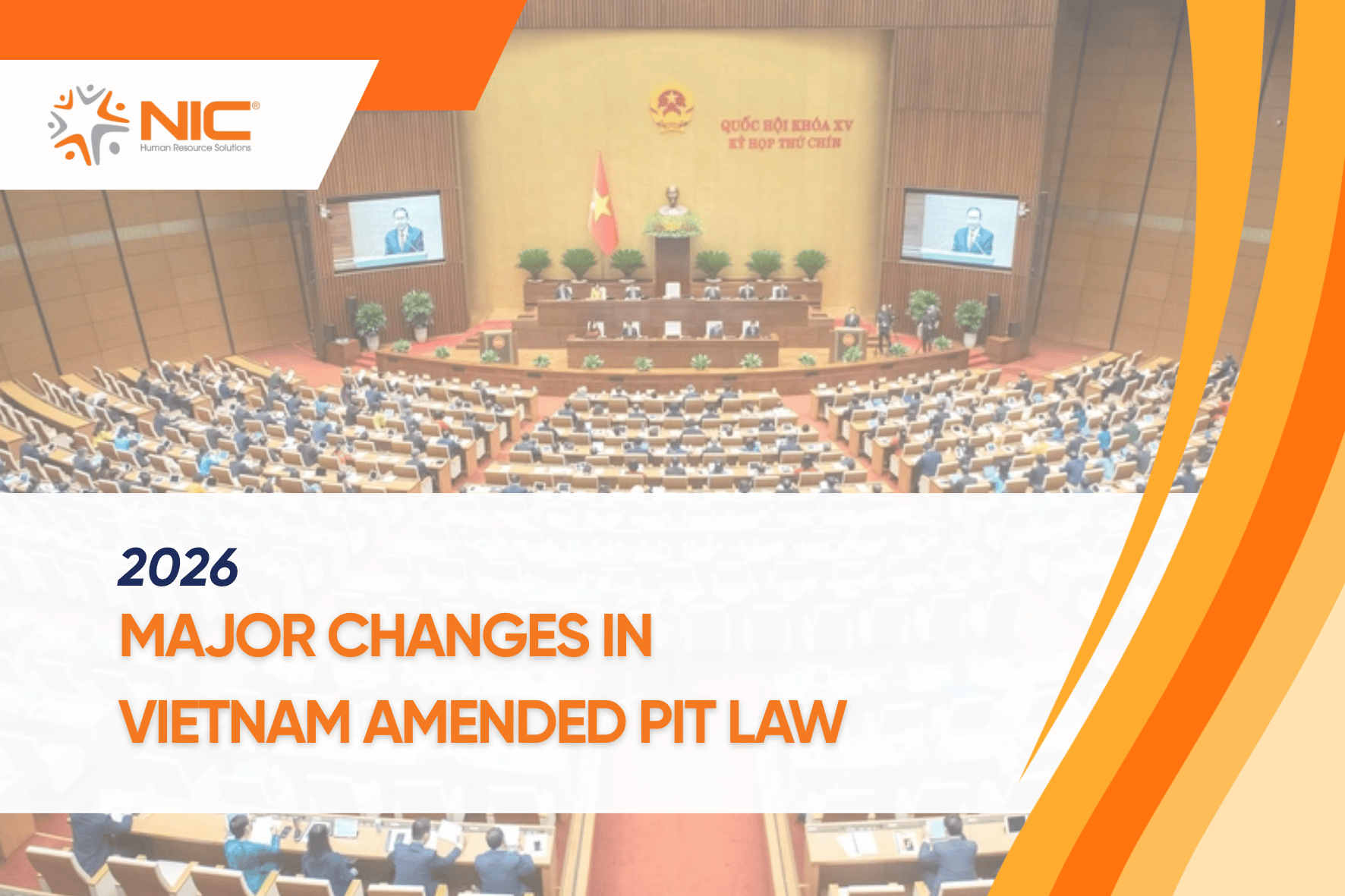
On December 10, 2025, the National Assembly officially passed the amended Personal Income Tax (PIT) Law, marking a significant adjustment to tax policy to reflect current socio-economic conditions. With 438 out of 443 delegates voting in favor, the revisions are considered to have a positive impact on most taxpayers by reducing financial burdens and creating greater fairness among income groups.
NIC Global has compiled and analyzed the most notable updates to help employees, managers, and businesses stay fully informed.
1. Progressive Tax Brackets Adjusted to 5 Levels – Reduced Rates for Brackets 2 and 3
During the approval session, the Ministry of Finance presented its explanatory report, clarifying adjustments to the progressive tax brackets. While the structure remains at 5 brackets, tax rates for the two middle brackets have been lowered to reduce the burden on the majority of taxpayers.
Key adjustments:
- The 15% tax rate in bracket 2 is reduced to 10%
- The 25% tax rate in bracket 3 is reduced to 20%
These changes help ensure the tax structure better reflects actual income levels and avoid sudden jumps in tax obligations near bracket thresholds.
Why the 35% Top Rate in Bracket 5 Remains Unchanged
A point of public interest was whether the highest tax rate of 35% would be adjusted. Minister Nguyễn Văn Thắng stated that maintaining the 35% top rate for income from salaries and wages is a reasonable proposal.
He explained that this rate falls within the global average range and is consistent with many regional countries, such as Thailand, Indonesia, and the Philippines (all at 35%), while China’s top rate is 45%. Reducing the rate to 30% could be interpreted as favoring high-income groups.
2. New 0.1% Tax on Gold Bar Transactions
A notable market-management measure is the introduction of PIT on gold bar transactions.
Under the new law, individuals must pay:
- 0.1% tax on the transfer price of each gold bar transaction
This policy aims to strengthen supervision over the gold market, which has long been volatile and an attractive non-productive investment channel.
Objectives of the new regulation:
- Improve transparency in gold transactions
- Limit speculation and price manipulation
- Redirect capital toward productive economic activities
- Establish a legal foundation for flexible tax adjustments based on market conditions
The Government will decide the specific implementation date and future rate adjustments depending on the gold market environment.
3. Significant Increase in Family Circumstance Deductions – Direct Benefit for Employees
One of the most impactful changes for employees is the increase in family circumstance deductions.
According to the amended law:
- Deduction for taxpayers: 15.5 million VND/month (186 million VND/year)
- Deduction per dependent: 6.2 million VND/month
These adjustments reflect rising living costs and inflation in recent years.
The law also authorizes the Government to propose future adjustments based on:
- Living standards
- Consumer prices
- Average income
- Socio-economic conditions
This ensures tax policies can adapt promptly rather than waiting years for legislative revisions.
4. Real Estate Transfers: 2% Tax Rate Remains unchanged
For income from real estate transfers, the law maintains the current mechanism:
PIT = Transfer value × 2%
This rate is considered appropriate for market management and ensures stable state revenue. Tax liability is determined when the transfer contract takes effect or when ownership/land use rights are registered.
5. Effective Dates & Impact on Employees and Businesses
The amended PIT Law will officially take effect:
- From July 1, 2026, for most provisions
- From the 2026 tax year for income from wages and salaries
Groups that benefit directly:
- Middle-income earners (taxpayers in brackets 2 and 3)
- Families with many dependents
- Office, technical, and service workers — groups most commonly subject to PIT
Indirect impact on businesses:
- Reduced financial pressure on employees
- Lower demand for wage increases due to living-cost burdens
- Improved employee stability and retention
6. How NIC Global Supports Businesses & Employees in Adapting to the New Law
With deep expertise in HR management, payroll, and compliance consulting, NIC Global is ready to assist organizations once the new law takes effect.
For businesses:
- Guidance on updating new tax brackets into payroll systems
- Compliance-aligned HR cost optimization
- Payroll–tax–insurance management via NIC Global’s Payroll Service
- Support for FDI and foreign companies through EOR & HR Outsourcing
For employees:
- Fast and accurate updates on tax & insurance regulations
- Assistance with PIT deduction and compliance questions
- Transparent information across NIC-managed projects
The amended Personal Income Tax Law brings multiple positive changes:
reducing tax burdens for most employees, increasing family deductions, introducing gold-bar transaction management, and maintaining stability in real estate taxes. These updates help ensure the tax system reflects real social and economic conditions.
NIC Global will continue to provide timely policy updates and support businesses and employees in achieving accurate and efficient compliance.
For contact and support:
Facebook: NIC Global – Human Resource Solutions
LinkedIn: NIC Global Sourcing JSC
Website: www.nicvn.com
Email: info@nicvn.com
Hotline: (+84) 981.23.43.76
Address:
- Hanoi Office: No. 3A Thi Sach, Hai Ba Trung Ward, Hanoi, Vietnam
- Ho Chi Minh City Office: Dakao Center Building, 35 Mac Dinh Chi, Sai Gon Ward, Ho Chi Minh City, Vietnam
See more:
Payroll service
Staffing service
EOR service